Regional Plant Appraisal Committee and Guides
Kyle Daniel
Nursery and Landscape Industry Representative
Nursery and Landscape Outreach Specialist
Department of Horticulture and Landscape Architecture
Purdue University
daniel38@purdue.edu
Phone: 765-494-7621
Term expires December 2026
Jeff Ling
RCA #337
Chair
Arborwise
PO Box 6553
Fort Wayne, IN 46896
260-402-6016
Jud Scott
RCA #382
Jud Scott Consulting Arborist LLC
4721 E 146th Street
Carmel IN 46033
jud@judscottconsultingarborist.com
317-815-8733
Andrew Mertz
RCA #542
indigotreeconsulting@gmail.com
317-508-4150
Lindsey Purcell
RCA #673
info@lpconsultinggroup.org
219-213-6255
David Gorden
Mark H. Holeman Landscape Architects
317-849-3120
Assignment: The 10th edition of the Guide for Plant Appraisal emphasizes the importance of establishing a Regional Plant Appraisal Committee (RPAC) to ensure the accuracy and relevance of regional data used in the appraisal process. The committee is tasked with maintaining and regularly updating this information according to current market conditions and nursery availability.
- Deciduous Trees: The largest commonly available nursery-grown deciduous tree in Indiana is characterized by a trunk caliper diameter of 3.5 inches.
- Conifers: The largest commonly available nursery-grown conifer in Indiana features an average trunk caliper measurement of 3 inches on 10 foot trees.
- Determine regional cost information for the wholesale price of the largest commonly available nursery-grown tree.
- Determine average costs for shipping and installation for a single tree.
- Determine an average maintenance cost for that tree for one year which includes mulch, watering and tree support system.
- Determine the Basic Unit Cost for application in the trunk formula technique.
- Define species ratings for common Indiana trees.
Identification of the Largest Commonly Available Nursery-Grown Tree
To fulfill its responsibilities, the RPAC conducted a comprehensive statewide survey of nurseries. This survey was designed to identify the largest commonly available nursery-grown trees offered at wholesale prices. The data collected was thoroughly compiled and analyzed to determine the prevailing standards in Indiana.
Regional Cost Information for Nursery-Grown Trees in Indiana
The Regional Plant Appraisal Committee conducted a detailed review of the costs associated with the largest commonly available nursery-grown tree in Indiana. Their findings are based on a thorough analysis of wholesale pricing, as well as the expenses related to shipping, installation, and one year of post-planting maintenance. The results are organized as follows:
- Wholesale Price: The wholesale price for the largest commonly available nursery-grown tree in Indiana is determined to be $329.
- Planting Cost: The cost associated with planting this tree, including labor and any necessary materials, totals $685.
- Post-Planting Maintenance: Maintenance for one year following installation, which may include watering, fertilization, and other routine care, is estimated at $290.
- Unit Cost for Trunk Formula Technique (TFT): For all tree appraisals utilizing the Trunk Formula Technique in Indiana, the established unit cost is $36.50 per square inch of trunk cross-sectional area.
Identification of the Largest Commonly Available Nursery-Grown Tree
To fulfill its responsibilities, the RPAC conducted a comprehensive statewide survey of nurseries. This survey was designed to identify the largest commonly available nursery-grown trees offered at wholesale prices. The data collected was thoroughly compiled and analyzed to determine the prevailing standards in Indiana.
- Deciduous Tree: The largest commonly available nursery-grown deciduous tree in Indiana is characterized by a trunk caliper diameter of 3.5 inches.
- Conifers: The largest commonly available nursery-grown conifer in Indiana features a trunk caliper diameter of 3 inches on 10 foot trees.
Regional Cost Information for Nursery-Grown Trees in Indiana
The Regional Plant Appraisal Committee conducted a detailed review of the costs associated with the largest commonly available nursery-grown tree in Indiana. Their findings are based on a thorough analysis of wholesale pricing, as well as the expenses related to shipping, installation, and one year of post-planting maintenance. The results are organized as follows:
- Wholesale Price: The wholesale price for the largest commonly available nursery-grown tree in Indiana is determined to be $329.
- Planting Cost: The cost associated with planting this tree, including labor and any necessary materials, totals $685. This price includes excavating the planting pit, watering, mulch and basic tree support system for an individual tree.
- Post-Planting Maintenance: Maintenance for one year following installation, which may include watering, fertilization, and other routine care, is estimated at $290.
- Unit Cost for Trunk Formula Technique (TFT): For all tree appraisals utilizing the Trunk Formula Technique in Indiana, the established unit cost is $36.50 per square inch of trunk cross-sectional area.
These cost components are essential for accurate tree appraisal and provide a standardized reference for professionals applying the Trunk Formula Technique within the state.
This information will be updated as needed by the committee as needed or indicated by the Council on Landscape and Tree Appraisal. The Indiana Arborist Association would like to thank the committee for their time and effort assisting industry professionals.
Indiana Guide for Rating for Landscape Trees — This document presents a sample list of plant species commonly found in Indiana landscapes, encompassing both native and non-native varieties. Each species is assigned a single rating applicable to the state, though ratings may differ by specific location within Indiana. The list is intended to be representative rather than exhaustive, highlighting the majority of species prevalent in urban forests. Ratings are based on comparative evaluations of climate adaptability, growth habits, site suitability, and tolerance to various biotic and abiotic stressors. It is essential to note that there is no direct correlation between the species ratings provided and functional limitation ratings.
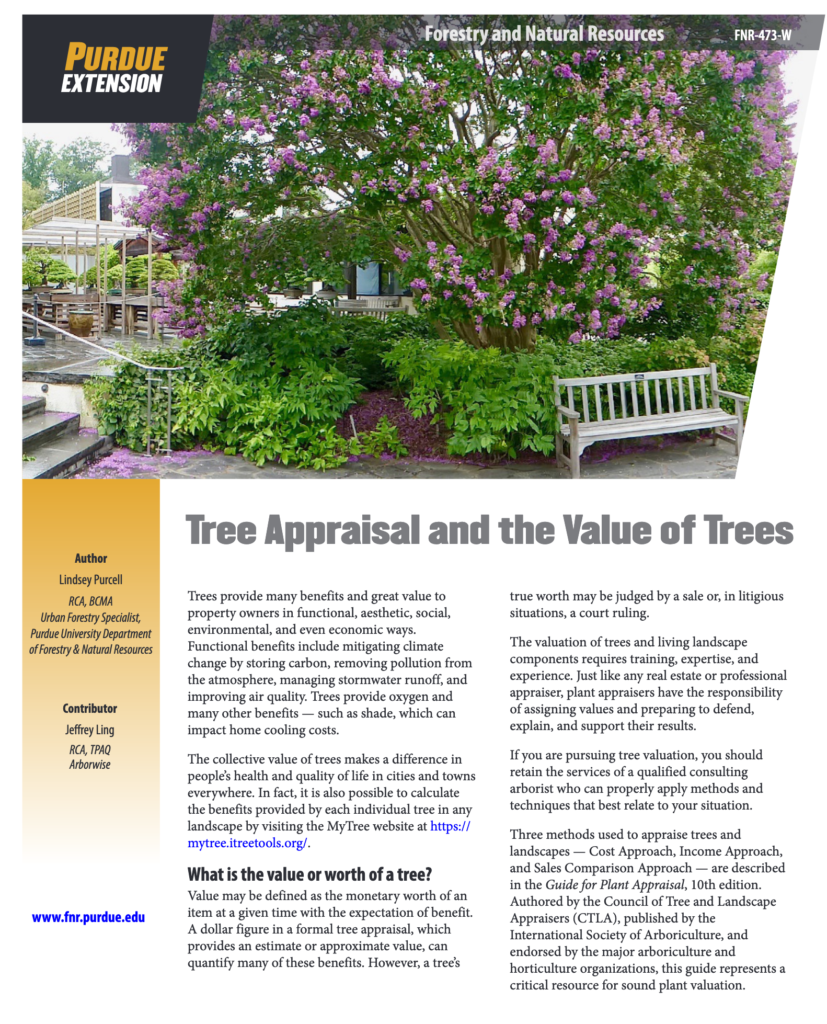
Tree Appraisal and the Value of Trees — Trees offer a wide range of benefits to property owners, encompassing functional, aesthetic, social, environmental, and economic values. Among their functional contributions are carbon sequestration, atmospheric pollution removal, stormwater management, and air quality improvement. Additionally, trees supply oxygen and provide shade, which can contribute to reduced home cooling expenses.
Trees contribute significantly to public health and overall quality of life within urban and suburban environments. The Purdue Extension publication on tree appraisal outlines an established methodology for appraising trees, detailing the Trunk Formula Technique criteria to assess their value, the rationale behind conducting tree appraisals, factors influencing appraisal outcomes, interpretation of appraisal ratings, and illustrative case studies.
Conditional Statement
The Indiana Regional Plant Appraisal Committee (IN RPAC) acknowledges the 10th edition of the Guide for Plant Appraisal as the standard reference for plant appraisal and advises consulting this guide when performing professional consulting services related to valuing trees, landscapes, and related elements. The species rating guide serves as a baseline for common species, based on limitations identified by tree professionals in Indiana. Consulting arborists are responsible for selecting the appropriate methodology and rating for each species.